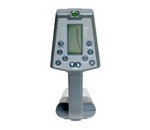

Megger Sebakmt Digiphone+ Acoustic Cable Fault Pinpointing Receiver
The Megger Sebakmt Digiphone+ is the surge wave receiver used to acoustically and electromagnetically pinpoint cable faults on power cable, after the fault has been pre-located with a TDR or surge generator. Powerpoint Engineering supplies the Digiphone+ to Irish utilities, HV / MV cable contractors, and renewable site operators who need to convert a "fault is around 1,200 metres in" pre-location into a precise location on the ground that the excavator goes to first time.
Pre-location gets you close. Pinpointing gets you to the metre. Without a good pinpointing receiver, every cable repair turns into a long, speculative trench. With a Digiphone+, the same job is a planned excavation at a known mark on the ground.
How the Digiphone+ pinpoints a fault
- Acoustic detection: a surge generator (thumper) discharges into the cable at regular intervals; the resulting acoustic pulse at the fault travels up through the soil and is picked up by the ground microphone on the Digiphone+.
- Electromagnetic detection: the same surge produces an electromagnetic pulse along the cable; the receiver detects the pulse on a separate channel.
- Combined acoustic and electromagnetic measurement: the unit measures the time delay between the EM pulse arrival and the acoustic pulse arrival, presenting a fault arrow that indicates the direction to the fault.
- Walk and converge: the operator walks along the cable route, watching the fault arrow and listening to the fault noise on headphones, until both signals converge at the fault point.
- Cable routing and expert cable tracing when paired with a transmitter, allowing the route of an unknown buried cable to be confirmed before any excavation starts.
Why combined acoustic plus EM matters
Acoustic-only methods can be fooled by traffic, weather, and noisy industrial environments. Electromagnetic-only methods can be fooled by parallel cables and crossings. Combining the two, with the time delay between them as the primary location indicator, is what gives the Digiphone+ the discrimination to find a fault under a busy footpath, a wet site, or a dense urban substation environment where simpler tools struggle.
Specifications: what to confirm before you order
|
Specification |
What to confirm |
|
Channels |
Acoustic and electromagnetic, with combined fault arrow display |
|
Sensors |
Ground microphone and EM sensor accessories supplied for the cable types you locate |
|
Surge compatibility |
Trigger interface for Megger and Sebakmt surge generators (thumpers) |
|
Headphones |
Noise-cancelling headphones to hear the fault clearly on noisy sites |
|
Sheath fault feature |
Step-voltage receiver mode for cable sheath fault pinpointing |
|
Calibration |
Supplied calibrated; periodic recalibration through Powerpoint's lab |
Target users and applications
- Utilities and DNOs locating cable faults on MV and LV distribution networks
- HV and MV cable contractors carrying out fault location campaigns on transmission and distribution cable
- Industrial maintenance teams pinpointing faults on plant cable runs
- Renewable site operators locating faults on wind, solar, and BESS collector cable
- Cable-tracing specialists confirming buried cable routes before civil works
Typical applications include final pinpointing of cable faults after TDR pre-location, sheath fault pinpointing using step-voltage methods, cable routing and tracing for unknown buried cable, and verification of repair location after a joint or section replacement. As authorised Megger distributor in Ireland, Powerpoint Engineering supplies the Digiphone+ alongside the wider Megger Sebakmt fault location range and supports it with in-house calibration and repair.
FAQs
What is the difference between fault pre-location and pinpointing?
Pre-location uses methods like TDR, surge wave, ARM, and ICE to estimate the distance to the fault from one end of the cable. Pinpointing converts that distance into a precise location on the ground, usually within a metre, so excavation can be targeted. The Digiphone+ is a pinpointing receiver, used after pre-location.
Will the Digiphone+ work for cable sheath faults as well as conductor faults?
Yes, with the appropriate sensor accessory. The Digiphone+ supports step-voltage methods for cable sheath fault pinpointing in addition to acoustic and electromagnetic conductor fault pinpointing, covering both common fault types from one receiver.
Does the Digiphone+ need a thumper to work?
For conductor fault pinpointing, yes. The acoustic and electromagnetic events the Digiphone+ detects are produced by a surge generator (thumper) discharging into the cable. For cable tracing, the unit pairs with a low-power transmitter instead.
To match the right Digiphone+ kit to your fault location workflow and cable types, request a quote or speak to our team for compatibility advice.
SebaKMT digiPHONE+ Datasheet
For additional technical details about the SebaKMT digiPHONE+ please refer to the product datasheet.