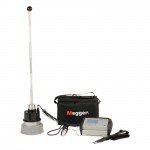

Sheath Fault Locator (Cable Sheath Testing & Fault Location)
A sheath fault locator is the cable test equipment used to detect and pinpoint damage to the outer sheath of MV and HV power cables. Powerpoint Engineering supplies sheath fault location systems to Irish utilities, DNO contractors, and industrial maintenance teams who need to find and fix sheath damage before it becomes a recurring earth fault, a corrosion problem, or a full cable failure.
Sheath integrity is not a glamorous topic, but a defective cable sheath admits moisture, lets cross-bonded sheath currents go where they should not, and corrodes the conductor screen. Locate the fault accurately, dig once, repair once. Locate it badly and the same trench gets opened twice.
What a sheath fault locator does
- Sheath integrity testing: a high-resistance DC sheath test confirms whether the outer sheath is intact across the cable length.
- Cable sheath fault pre-location: bridge or pulse-echo methods estimate the distance to the fault from one end of the cable.
- Sheath fault pinpointing: surface step-voltage measurement walks the cable route to fix the exact ground location of the fault, often within a metre.
- Combined cable fault location: where the system supports it, sheath testing sits in the same workflow as conductor fault location, so one test van covers the full cable fault location job.
The combined sheath test plus pre-location plus pinpointing workflow is what makes the system more than a simple fault locator. You confirm a fault exists, narrow it to a section, then walk to it on the ground, with measurement evidence at each step.
Why measurement accuracy matters in sheath fault location
The cost of a sheath fault is mostly the civil works, not the test. Locating the fault to within a metre means a small, planned excavation; locating it to within fifty metres means a long trench, traffic management, and downtime. Modern sheath fault location systems (Baur, Megger, and the wider fault location range) deliver the accuracy needed to make that civil decision a small one. Murray loop and similar bridge methods underpin the pre-location step, with surface step-voltage methods completing the pinpointing.
Specifications: what to confirm before you order
|
Specification |
What to confirm |
|
Sheath test voltage |
DC test voltage matched to cable type and IEC sheath test recommendations |
|
Pre-location method |
Bridge (Murray), pulse-echo, or combined methods supported |
|
Pinpointing |
Surface step-voltage receiver and probe set for accurate ground location |
|
Cable length / distance |
Maximum distance to the fault the system can resolve |
|
Integration |
Standalone unit or part of a wider cable fault location system on a test van |
|
Calibration |
Supplied calibrated; periodic recalibration through Powerpoint's lab |
Target users and applications
- Utilities and DNOs locating sheath faults on MV and HV distribution cable
- HV and LV contractors carrying out sheath testing after installation, civil works, or third-party cable damage
- Cable jointing teams confirming sheath integrity before and after joint or termination work
- Industrial maintenance teams investigating recurring earth faults on plant cable runs
- Renewable site engineers testing collector and export cable on wind, solar, and BESS networks
Typical applications include post-installation sheath testing on new cable runs, fault investigation after recurring earth faults, condition assessment of long-installed cable, and acceptance testing as part of a full cable fault location and diagnostic test on a single outage.
Powerpoint Engineering supports sheath fault location systems with in-house calibration and repair, accessory supply, and operator training, alongside the wider cable test and diagnostic equipment range for utility and industrial cable work in Ireland.
FAQs
What is the difference between a sheath fault and a conductor fault?
A sheath fault is damage or insulation breakdown in the outer cable sheath, which can lead to moisture ingress and corrosion. A conductor fault is in the cable cores themselves and stops or shorts the supply. Sheath fault locators find the first kind; conductor fault locators (TDR, surge wave, ARM) find the second. Modern systems often combine both.
How accurate is a sheath fault locator?
With a combined pre-location plus surface pinpointing workflow, sheath faults can routinely be located to within a metre on the ground, depending on cable type, length, and soil conditions. That accuracy is what keeps excavation costs down on a typical cable repair.
Can the same system locate sheath and conductor faults?
On many modern fault location systems, yes. Sheath testing sits alongside TDR, surge wave, and ARM-based conductor fault location in a single test van or skid system. Send us your cable types, voltages, and typical fault scenarios and we will recommend the right configuration.
To match the right sheath fault locator and cable fault location system to your network, request a quote or speak to our team for compatibility advice.
Seba KMT MFM 10 - Sheath Fault Location System Datasheet
For additional technical details about the Seba KMT MFM 10 - Sheath Fault Location System please refer to the product datasheet.