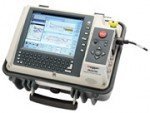

Megger (Programma) TORKEL 840 Utility Battery Load Tester
The Megger Programma TORKEL 840 is a utility battery load tester designed for capacity and discharge testing of stationary battery systems on substations, telecom plant, UPS rooms, and renewable power sites. Powerpoint Engineering supplies the TORKEL 840 to Irish utilities, electrical engineers, electrical contractors, and critical-power maintenance teams who need a portable battery load unit that proves the actual capacity of a battery string against its specified autonomy time.
An open-circuit voltage check tells you the battery is "there". A controlled discharge through the TORKEL 840 tells you whether it can actually carry the load when the mains drops. For substation DC systems, generator starting batteries, and UPS plant, that is the only test that matters.
What the TORKEL 840 measures
- Battery capacity (Ah): discharge the battery against a known constant current, capture voltage profile through the test, and record the actual delivered Ah against the specified rating.
- Voltage behaviour under load: catch weak cells, weak blocks, and uneven discharge that show up as early voltage roll-off in the trace.
- Runtime against required autonomy time: pass / fail decision against the design specification of the battery system.
- Constant current discharge: stable, repeatable load profile that gives directly comparable results across return visits.
- Per-cell or per-block voltage: when paired with the Megger BVM accessory, capture cell-by-cell voltage during the discharge to identify weak cells before they fail the string.
Recorded data exports to TORKEL Viewer software for trending, ISO-friendly reporting, and inclusion in the maintenance record. That is what turns a battery test into a defensible capacity test that satisfies asset owners, insurers, and audit trails.
Battery systems the TORKEL 840 is designed for
The 840 covers utility-class stationary battery banks ranging from 12 V plant batteries upward through the substation control battery voltages typical on Irish networks. It is the right unit for:
- Substation control and protection DC systems
- Telecom DC plant batteries
- UPS battery banks in commercial and industrial sites
- Generator starting batteries on standby plant
- BESS support batteries on wind, solar, and grid-support sites
For higher-current strings or large data-centre UPS banks where the 840 alone is not enough, two or more TORKEL 840 units can be paralleled with extra load units to deliver the discharge current the test plan demands. The same control workflow, the same data file, the same pass / fail logic across the parallel set.
TORKEL 840 vs TORKEL 950
Both are TORKEL battery load testers from the same Megger Programma family. The 840 is the utility-focused unit, sized and weighted for substation control battery work and routine periodic capacity testing. The 950 is the higher-capacity variant aimed at large UPS and data-centre battery banks. Most Irish substation maintenance teams find the 840 the right balance of capability, portability, and cost for everyday battery test work.
Specifications: what to confirm before you order
|
Specification |
What to confirm |
|
Voltage range |
Battery system voltage from low DC up to the maximum supported by the unit |
|
Discharge current |
Maximum continuous current matched to your largest planned test |
|
Test modes |
Constant current discharge, with pre-set test plans and end-voltage termination |
|
Cell monitoring |
BVM modules for per-cell or per-block voltage capture during the discharge |
|
Software |
TORKEL Viewer for setup, live monitoring, and report generation |
|
Calibration |
Supplied calibrated; periodic recalibration through Powerpoint's lab |
Target users and applications
- Utilities and DNOs running periodic capacity testing on substation DC and protection battery banks
- UPS and data-centre teams carrying out acceptance and periodic battery capacity testing
- Telecom operators verifying autonomy of DC plant batteries
- Renewable power operators testing BESS support batteries and starting batteries on standby plant
- Electrical contractors performing commissioning and maintenance battery discharge tests on behalf of asset owners
Typical applications include acceptance testing of new battery systems, periodic capacity testing under IEEE-style schedules, post-replacement verification, and fault investigation when a battery system has failed an autonomy expectation.
As authorised Megger distributor in Ireland, Powerpoint Engineering supports the TORKEL 840 with in-house calibration and repair, BVM accessory supply, and operator training for capacity testing on substation, UPS, and telecom battery banks.
FAQs
Why use a battery load unit instead of an impedance tester?
Impedance testing is fast and useful for screening large battery fleets, but it does not directly measure capacity. The TORKEL 840 performs an actual controlled discharge against a constant current load and records the voltage profile, which is the only way to prove the real Ah capacity of the string. The two methods are complementary, not interchangeable.
Can two TORKEL 840 units be used in parallel?
Yes. Two or more TORKEL 840 units can be paralleled to deliver higher discharge currents than a single unit can manage on its own, with the test sequenced and reported as a single test from the operator's point of view. That is the standard approach for large UPS and data-centre battery testing.
Does the TORKEL 840 need calibration?
Yes. As a precision test instrument used for acceptance and capacity reporting, the TORKEL 840 should be recalibrated periodically. Powerpoint Engineering's calibration laboratory recalibrates Megger TORKEL units in-house and supplies a traceable certificate.
To match the right Megger Programma TORKEL 840 configuration to your battery systems, discharge current needs, and reporting requirements, request a quote or speak to our team for compatibility advice.
Megger (Programma) TORKEL 840 Battery Load Unit Datasheet
For additional technical details about the Megger (Programma) TORKEL 840 Battery Load Unit please refer to the product datasheet.